For Eminem, fame did not arrive as a clean ascent. It arrived as separation. The transformation from Marshall Mathers to Eminem introduced protection, structure, and permanence — but it also introduced distance. The environments that had once shaped him became inaccessible. The people who had once stood beside him could no longer reach him the same way. Fame did not simply elevate his life. It reorganized it, placing barriers between who he had been and who he had become.
That distance became irreversible on April 11, 2006.
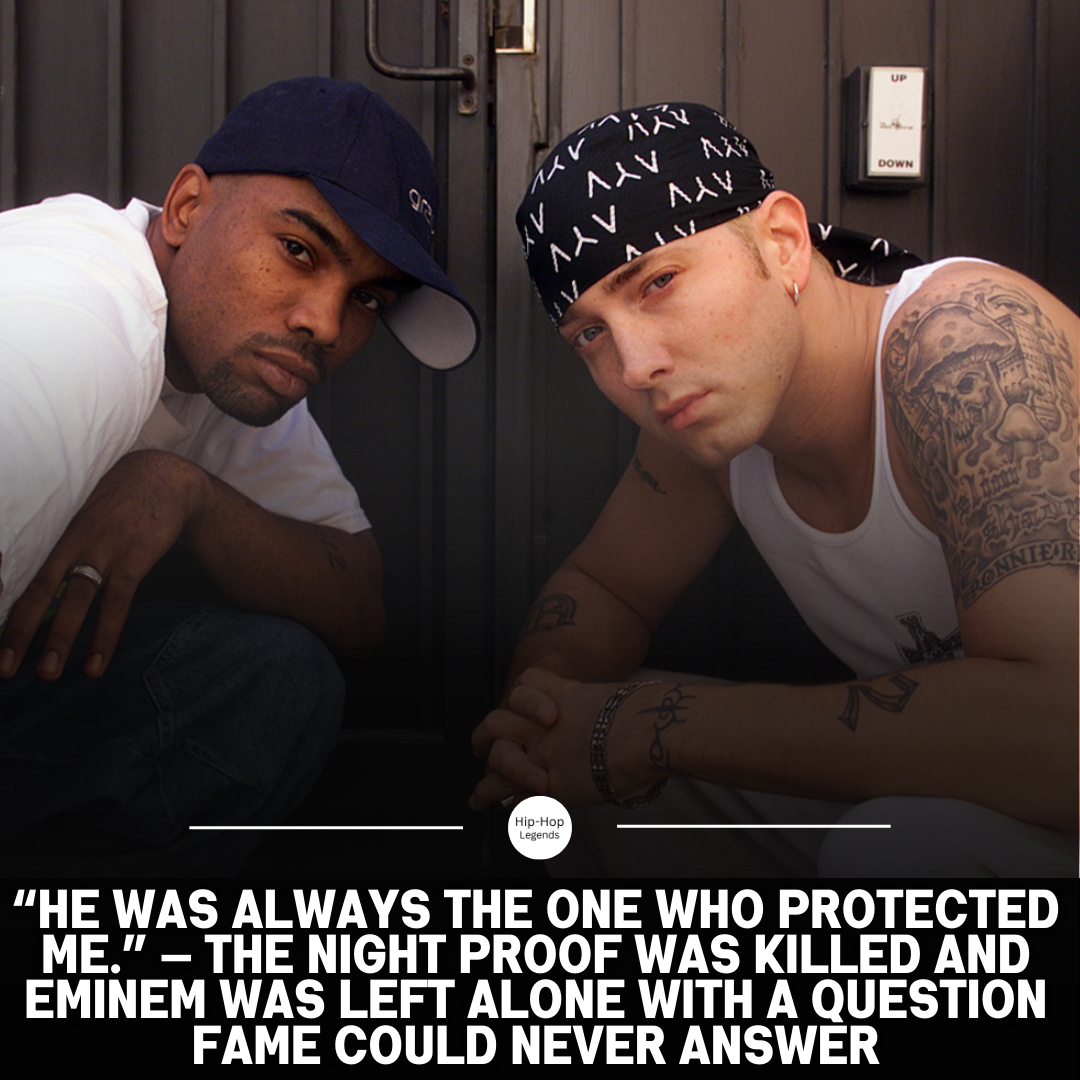
In the early hours of that morning, at Detroit’s CCC Club, Proof — born DeShaun Holton — was shot and killed following an altercation that escalated beyond recovery. He was not simply another figure from Eminem’s past. He was structural to it. Long before record deals or global visibility, Proof had served as a stabilizing force. He was the one who introduced Marshall to Detroit’s competitive rap circuits, who placed him in environments designed to test durability. Where others saw volatility, Proof saw direction. Where others saw uncertainty, he saw inevitability.
He did not just witness Eminem’s emergence. He helped construct it.
But by 2006, the conditions surrounding Eminem had fundamentally changed. Success had reorganized his existence into controlled spaces, governed by management, security, and expectation. Access to him was no longer immediate. At the same time, he was moving through a period defined by severe prescription drug dependency, a state that altered perception, judgment, and presence. The person who had once existed fully inside Detroit’s unpredictability was now increasingly removed from it.
And in that removal, something essential had been lost.
Proof remained rooted in the environment that had shaped them both. He continued to exist within the community that had once sustained Marshall before the system intervened. Their connection endured, but the conditions surrounding it were no longer equal. One had become infrastructure. The other remained human inside an unpredictable world.
When Proof was killed, the permanence of that separation became undeniable.
The aftermath did not present itself as public collapse. It manifested as withdrawal. Eminem stepped away from visibility, entering a period where absence replaced output. The system that had once accelerated his presence now contained his silence. In 2007, that silence deepened when he suffered a near-fatal overdose, an event that further reinforced how fragile the structure around him had become.
When he eventually returned, the music reflected a different kind of authorship. Songs such as “You’re Never Over” did not function as performances. They existed as acknowledgments of permanence — recognition that some presences continue structurally, even after they are physically removed. Proof was no longer part of Eminem’s present reality, but he remained embedded in its foundation.
There is a difference between losing someone and losing the conditions that made their presence possible. Proof belonged to a version of Eminem’s life that could no longer exist — a version unmediated by system, scale, or permanence.
Fame had preserved Eminem.
But it had also ensured he would never return to the place where Proof still lived.