By the time Kendrick Lamar entered Eminem’s studio, his legitimacy was already widely accepted. He had established himself as a writer capable of building entire narratives from internal conflict alone. His authority did not depend on imitation. It depended on authorship. He did not need external validation to confirm what his work had already demonstrated.
But Eminem did not rely on reputation.
He relied on process.
And process, unlike reputation, could be observed directly.
Why Eminem Didn’t Accept the Verse Until He Saw It Written
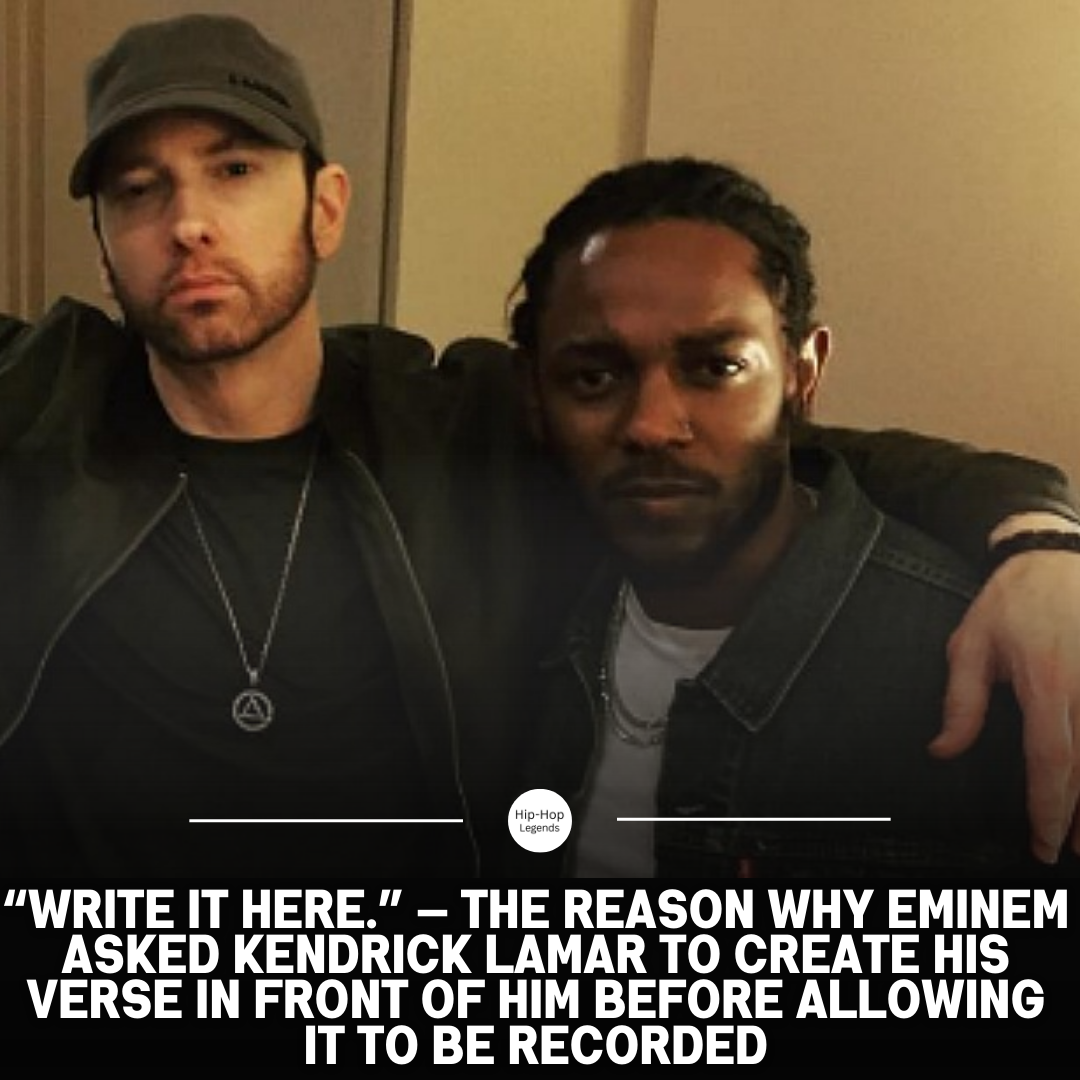
When Kendrick arrived to record their collaboration “Love Game,” Eminem asked him to do something unexpected. He asked him to write the verse inside the studio, in real time.
Not to revise it.
To create it there.
This was not framed as suspicion. It was framed as structure. Eminem did not want a verse that existed independently of the moment. He wanted a verse that could be traced to its origin without interruption. Something that had not passed through any external filtration before reaching the microphone.
Because in Eminem’s framework, writing was not preparation.
It was identity.
The person writing the words had to be the person speaking them.
Anything else introduced distance.
The Principle Eminem Had Protected Since the Beginning
From the start of his career, Eminem had defined himself through authorship. His authority came from the fact that every line carried his internal architecture. He did not inherit language from others. He constructed it himself. This independence was not optional. It was structural.
Ghostwriting, in this context, represented more than collaboration.
It represented displacement.
It created uncertainty about where the person ended and the performance began.
Eminem did not operate inside that uncertainty.
He eliminated it.
What Eminem Was Actually Observing
Kendrick did not resist the request. He remained inside the studio and began writing. There was no attempt to defend his legitimacy verbally. He allowed the process itself to provide the confirmation.
Eminem watched.
Not as a judge.
As a witness.
He observed the pace. The hesitation. The revisions. The construction of rhythm before sound. The way Kendrick moved between silence and articulation. These details could not be fabricated. They existed only in real time.
The verse did not arrive fully formed.
It arrived through effort.
This was the evidence Eminem required.
Why the Verse Mattered Less Than the Process Behind It
When Kendrick eventually recorded his verse, its quality was already expected. Technical proficiency was not the variable being measured. The variable was origin. Whether the words emerged directly from the person delivering them.
Once that condition was satisfied, the performance became secondary.
Because authorship had already been secured.
Eminem did not need to ask further questions.
The uncertainty had been removed.
What This Moment Revealed About Eminem’s Relationship With Authorship
Eminem’s request was not designed to isolate Kendrick. It was designed to preserve a principle Eminem had built his entire career around. The principle that writing was not transferable. It could not be delegated without altering its meaning.
Authorship was not symbolic.
It was functional.
It determined whether the voice speaking could be traced to a singular internal source.
Eminem did not protect this principle selectively.
He protected it universally.
Including in the presence of someone already recognized as legitimate.
Why Eminem Never Needed to Ask the Question Again
After witnessing Kendrick’s process, Eminem did not revisit the issue. The observation had provided resolution. The verse existed. The origin was confirmed. The collaboration moved forward without qualification.
Publicly, Eminem would later identify Kendrick Lamar as one of the most significant lyricists of his generation. This recognition did not originate from distance. It originated from proximity. From having seen the process directly.
From having seen the words appear before they became permanent.
The microphone only captured the outcome.
Eminem had already seen the part that could not be recorded.