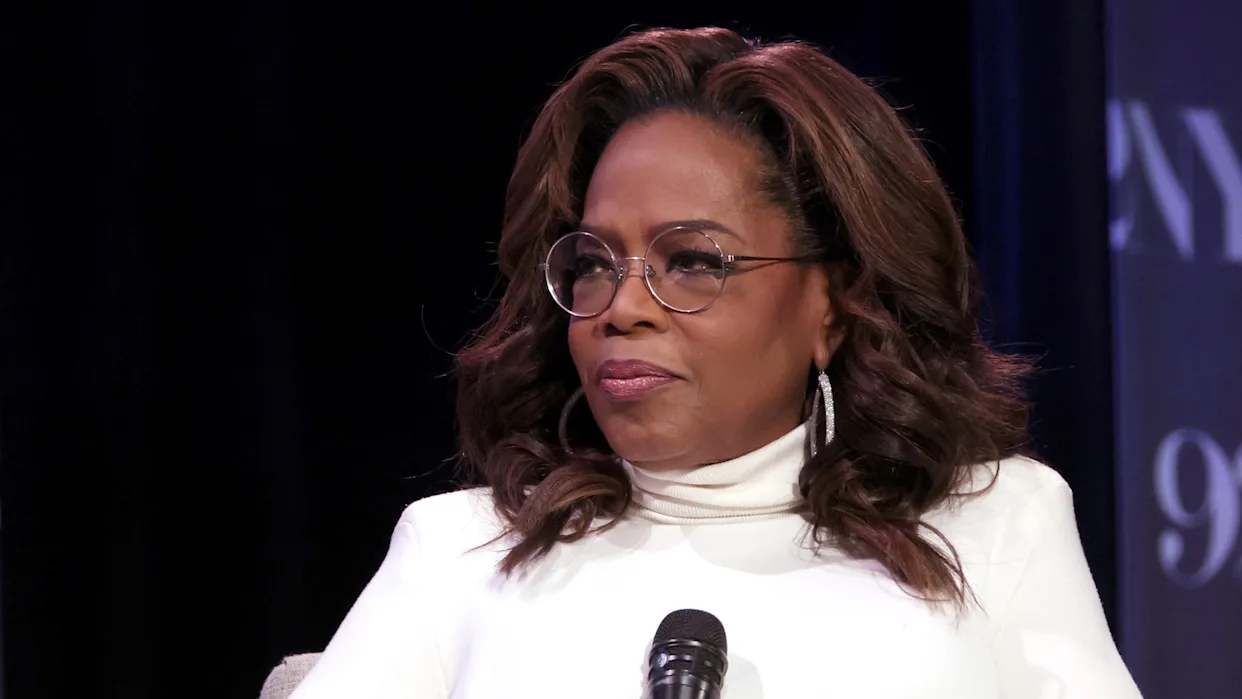
In the world of television, few names carry as much influence as Oprah Winfrey. For decades, her platform has shaped careers, elevated voices, and defined what success can look like in media. But every system built on influence carries its own complexities—and sometimes, those complexities resurface in unexpected ways.
Recently, renewed attention has turned toward Iyanla Vanzant, whose reflections on her past relationship with Oprah have stirred conversation across audiences. Not because they offer a single, definitive truth, but because they highlight how differently the same story can be understood depending on who tells it.

A Rise Forged Through Adversity
Long before television, Iyanla Vanzant’s life was marked by hardship. Born Rhonda Harris in Brooklyn, she faced early loss, instability, and trauma that shaped her path in profound ways. By her mid-twenties, she had already endured domestic violence, financial struggle, and personal loss.
Her transformation—from survival to success—didn’t happen overnight. Education became a turning point, leading her to law school and eventually into writing and speaking. Her voice, grounded in lived experience, resonated with audiences searching for guidance that felt authentic rather than theoretical.
That authenticity is what eventually brought her into Oprah’s orbit.
When Opportunity Meets Influence
In the late 1990s, Iyanla began appearing on The Oprah Winfrey Show, where her presence quickly stood out. Over multiple appearances, she connected with viewers in a way that felt both direct and deeply personal. She wasn’t just offering advice—she was translating pain into something people could understand.
For Oprah, who had built a platform around transformation and storytelling, Iyanla fit naturally into that space. Their professional relationship grew, and with it came the possibility of something larger: a show of her own.
At that point, everything seemed aligned.

The Moment Where Paths Diverged
What happened next depends on perspective.
As interest in Iyanla grew, so did external opportunities. Other networks and publishers saw potential, and the question of timing—when to expand, when to stay—became unavoidable.
According to Oprah’s account, Iyanla’s departure was framed as a spiritual decision. According to Iyanla, it was a practical question—whether it was the right moment to move forward.
What is clear is that communication between them broke down at a critical point. Conversations that might have resolved uncertainty instead became distant, filtered through representatives rather than handled directly.
The result was a split that neither side publicly reconciled at the time.

What Followed After the Break
After leaving Oprah’s platform, Iyanla launched her own show on network television. It did not last long. The cancellation marked the beginning of a difficult period—financial strain, personal loss, and a step away from the public eye.
At the same time, other figures associated with Oprah’s ecosystem continued to thrive. Names like Dr. Phil, Dr. Oz, and others expanded into their own media empires.
For observers, the contrast raised questions. Not necessarily about intent, but about outcomes—why some transitions succeed while others collapse.
The Return and the Narrative Reset
More than a decade later, Iyanla returned to Oprah’s platform.
The reunion was public, structured, and emotionally charged. On air, Iyanla expressed regret, framing the past in terms of misunderstanding and personal responsibility. Oprah accepted the apology, and the moment appeared, at least on the surface, to bring closure.
But outside that setting, Iyanla has occasionally suggested a more nuanced interpretation—one centered on expectations of loyalty and the dynamics that come with being closely associated with a powerful platform.
The two versions don’t cancel each other out. They exist side by side, reflecting the complexity of relationships shaped by both opportunity and hierarchy.
A Larger Conversation About Power
The renewed attention around this story has less to do with a single disagreement and more to do with what it represents.
Oprah’s influence is widely acknowledged as transformative. Her endorsement has launched careers and amplified voices that might otherwise have remained unheard. At the same time, stepping away from that influence can carry risks—professional, financial, and reputational.
This duality is not unique to Oprah. It reflects a broader reality in industries where visibility is concentrated and access is limited.
The conversation, then, becomes less about assigning blame and more about understanding structure: how power operates, how relationships evolve within it, and what happens when alignment breaks.
Public Perception and Private Realities
As with many high-profile relationships, the public only ever sees part of the story.
Moments are edited, framed, and presented in ways that serve a narrative. What remains unseen are the private conversations, the missed opportunities for clarity, and the decisions made in real time without the benefit of hindsight.
This is why stories like this continue to resurface. Not because they offer clear answers, but because they leave space for interpretation.
What Endures Beyond the Headlines
Despite the renewed scrutiny, Oprah’s legacy remains firmly established, built on decades of influence, philanthropy, and cultural impact. At the same time, Iyanla has rebuilt her own path, returning to television and continuing her work as a spiritual teacher and author.
Their stories did not end with their separation. They simply moved in different directions.
A Story Without a Single Conclusion
What makes this moment resonate is not the idea of exposure or revelation, but the recognition that success, mentorship, and independence rarely exist without tension.
The relationship between Iyanla Vanzant and Oprah Winfrey is not easily reduced to loyalty or betrayal. It is a story shaped by timing, communication, ambition, and the realities of navigating influence at the highest level.
And perhaps that is why it continues to hold attention—not because it provides a clear ending, but because it reflects something more familiar: the complicated balance between opportunity and autonomy, and the quiet cost that can come with both.