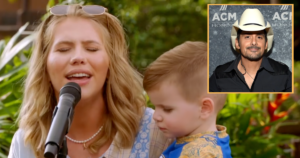
Reality singing competitions are built on standout moments—the kind that cut through the noise, stop the judges mid-sentence, and spark conversations far beyond the stage. In the 2026 season of American Idol, one such moment arrived during the high-stakes Hawaii round, when contestant Hannah Harper delivered a performance that didn’t just impress—it shifted how audiences and mentors saw her trajectory.
At the center of that moment was an unexpected but powerful endorsement from country music star Brad Paisley, whose reaction became as talked-about as the performance itself.
A Performance That Crossed the Line from Technical to Transformative
By the time contestants reach the Top 20, strong vocals are a given. What separates contenders from potential winners is something harder to quantify: presence, conviction, and the ability to make a song feel lived-in rather than performed.
Harper’s rendition of “Ain’t No Grave” landed precisely in that space.
Instead of leaning solely on vocal power, she built the performance with restraint and intention. The early moments felt intimate, almost conversational. As the song progressed, her delivery expanded—growing in intensity without losing control. That balance created a sense of narrative, as if the performance had an emotional arc rather than a fixed peak.
Judges responded to that shift immediately. Feedback centered less on pitch or tone and more on storytelling—an indication that Harper had crossed into a different category of performer. When a judge like Lionel Richie frames a performance as “sermon-like,” it signals that the artist is connecting on a deeper, almost spiritual level with the audience.
Brad Paisley’s Role: More Than Just a Guest Mentor
Guest mentors often offer quick tips or surface-level guidance. Paisley’s involvement in this round appeared more hands-on, focusing on how contestants communicate emotion—not just how they hit notes.
His reaction to Harper stood out because it felt less like routine praise and more like recognition of artistic identity. That distinction matters. When an established artist responds to a contestant as a peer-in-the-making rather than a student, it reframes how viewers perceive that contestant.
Paisley’s career has been built on storytelling within country music, where authenticity is everything. His endorsement implicitly signaled that Harper wasn’t just executing a performance—she was embodying the kind of storytelling that sustains long-term careers.
Why This Moment Resonated Beyond the Episode
Social media didn’t just react—it amplified. But the conversation wasn’t limited to “she sounded great.” Instead, viewers focused on three deeper elements:
1. Authenticity Over Perfection
Audiences are increasingly drawn to performances that feel real, even if they’re not technically flawless. Harper’s delivery leaned into emotion without over-polishing it, creating a sense of immediacy.
2. Visible Growth
Moments that feel like breakthroughs—rather than consistent competence—generate stronger engagement. Viewers could see a clear evolution in Harper’s artistry, making the performance feel earned.
Paisley’s reaction acted as a credibility multiplier. Fans often look to mentors to confirm what they’re feeling, and his response aligned with the audience’s instincts.
The Hawaii Round: Where Contestants Become Artists—or Don’t
The Hawaii stage of American Idol isn’t just another performance venue—it’s a pressure test.
For the first time, contestants must:
-
Perform for a live, high-energy audience
-
Balance camera presence with crowd engagement
-
Deliver under the weight of public voting
It’s also where the competition subtly shifts. Early rounds reward vocal ability; Hawaii demands identity. Contestants who can’t define themselves artistically often plateau here, while others—like Harper—use the moment to establish a clear point of view.
Mentorship plays a critical role in that transition. The right guidance can help a contestant move from “singing well” to “saying something.”
What This Means for the Rest of the Season
Breakout moments don’t guarantee a win—but they do change the playing field.
For Harper, this performance accomplished three things:
-
Positioning: She moved into the conversation as a serious contender
-
Narrative: Viewers now have a story to follow—growth, transformation, and potential
-
Expectations: Future performances will be judged against this new, higher standard
That last point is both an opportunity and a risk. Once a contestant delivers a defining moment, consistency becomes the challenge.
The Bigger Picture: Why Moments Like This Matter
Shows like American Idol endure because they create these rare intersections of talent, timing, and mentorship. A single performance—when supported by the right guidance and witnessed at the right stage—can redefine a contestant’s journey.
Harper’s Hawaii performance is a reminder that success in music competitions isn’t just about vocal ability. It’s about connection, storytelling, and the ability to make an audience feel something real in a matter of minutes.
And when a seasoned artist like Brad Paisley recognizes that spark, it doesn’t just validate the moment—it elevates it into something audiences won’t forget anytime soon.