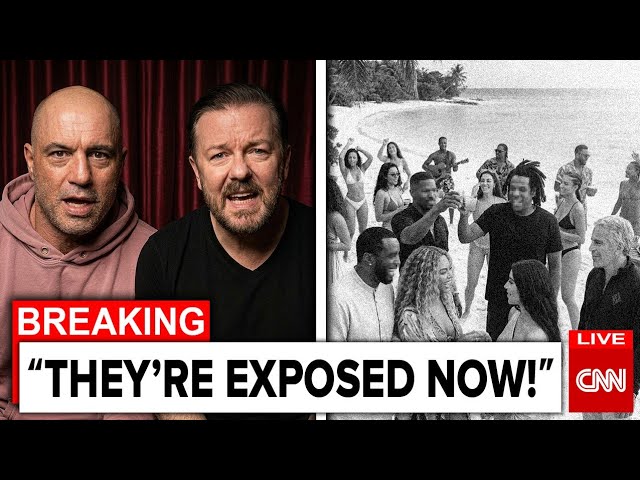
In the age of viral clips and algorithm-driven outrage, it doesn’t take much for speculation to harden into something that feels like fact. When familiar names like Ricky Gervais and Joe Rogan are attached to a narrative—especially one involving Jeffrey Epstein—the story spreads fast.
But speed isn’t accuracy.
What’s circulating online right now blends real events, public records, jokes, commentary, and outright conspiracy theories into a single storyline. To understand what’s actually going on, it’s worth separating verified information from interpretation—and interpretation from fiction.
The Origin: A Joke That Outlived the Moment
At the Golden Globe Awards in 2020, Ricky Gervais delivered a monologue that quickly became one of the most talked-about in recent memory.
His reference to Jeffrey Epstein—and his broader criticism of Hollywood elites—was designed to provoke. That’s his style: confrontational, irreverent, and deliberately uncomfortable.
Years later, that moment is being reframed online as a “warning” or “prophecy.”
In reality, it was satire aimed at celebrity culture and hypocrisy—not a coded exposé.

What the Epstein Documents Actually Represent
The release of documents connected to Epstein has fueled intense public interest. These records include:
-
Flight logs
-
Contact books
-
Legal filings and depositions
Here’s the critical distinction: being named in these documents does not imply criminal involvement.
High-profile individuals—such as Leonardo DiCaprio, Oprah Winfrey, and Tom Hanks—have been mentioned in various contexts, often secondhand or incidental.
In many cases:
-
They were referenced in emails or conversations
-
They were invited to events they may not have attended
-
Or their names surfaced without any allegation of wrongdoing
That nuance tends to disappear once the information hits social media.
The “Disappearing Celebrities” Narrative
A recurring claim suggests that celebrities are going silent or leaving the spotlight due to fear of exposure.
It’s a compelling idea—but it doesn’t hold up under scrutiny.
Public visibility fluctuates for many reasons:
-
Project cycles (filming, promotion, downtime)
-
Personal priorities
-
Business ventures outside entertainment
-
Media strategy shifts
For example, Oprah Winfrey has gradually transitioned away from daily television over years—not suddenly. Tom Hanks continues to work steadily, albeit more selectively.
What’s being framed as a coordinated “exodus” is more often normal career evolution.
Joe Rogan and the Expansion Into Conspiracy Culture
Joe Rogan is known for hosting wide-ranging, often speculative conversations. His platform thrives on exploring unconventional ideas—sometimes without firm conclusions.
That openness is part of the appeal. But it also creates space where:
-
Hypotheses can be mistaken for facts
-
Fringe theories gain mainstream visibility
-
Entertainment blurs into perceived reality
Claims about “clones,” “handlers,” or controlled celebrity replacements fall into this category. There is no credible evidence supporting such ideas, despite their popularity in certain online communities.
The Jim Carrey Example: When Perception Becomes Narrative
Recent online discussions about Jim Carrey highlight how quickly speculation can spiral.
Changes in appearance—lighting, aging, styling, even camera angles—are being interpreted as something more extreme. But this pattern isn’t new. Public figures have long been subject to exaggerated scrutiny over minor physical differences.
What’s changed is amplification. A single viral post can turn observation into “evidence” overnight.
Why These Stories Gain Traction
There’s a reason these narratives resonate:
1. Distrust of Power
Scandals involving real abuse of power make audiences more receptive to broader claims.
2. Pattern Recognition
People naturally connect dots—even when the dots aren’t connected.
3. Emotional Satisfaction
A hidden “truth” feels more compelling than a mundane explanation.
4. Algorithmic Incentives
Platforms reward content that provokes strong reactions—especially outrage or shock.
The Real Issue: Separating Accountability From Speculation
It’s important not to dismiss the seriousness of Epstein’s crimes or the broader conversations about exploitation in powerful circles. Those are real, documented issues.
But attaching unverified claims to unrelated individuals can:
-
Undermine legitimate investigations
-
Spread misinformation
-
Cause reputational harm without evidence
Accountability depends on facts—not viral narratives.
What Can Be Verified—and What Cannot
Verified:
-
Jeffrey Epstein was involved in a large-scale criminal network of abuse.
-
Legal documents related to his case have been released in phases.
-
Public figures have been named in various non-criminal contexts within those documents.
Not Verified:
-
That comedians or podcasters have revealed a complete “list” of guilty celebrities
-
That named individuals are involved in crimes without formal allegations or evidence
-
That celebrities are being replaced, controlled, or systematically silenced
Final Thought: The Cost of Believing Everything
The modern media landscape offers unprecedented access to information—but also to distortion.
When satire becomes “evidence,” and speculation becomes “truth,” the line between reality and narrative disappears.
The question isn’t whether powerful people should be scrutinized—they should be.
The question is whether the information guiding that scrutiny is reliable.
Because in a world flooded with claims, the most valuable skill isn’t knowing more—
It’s knowing what not to believe.