
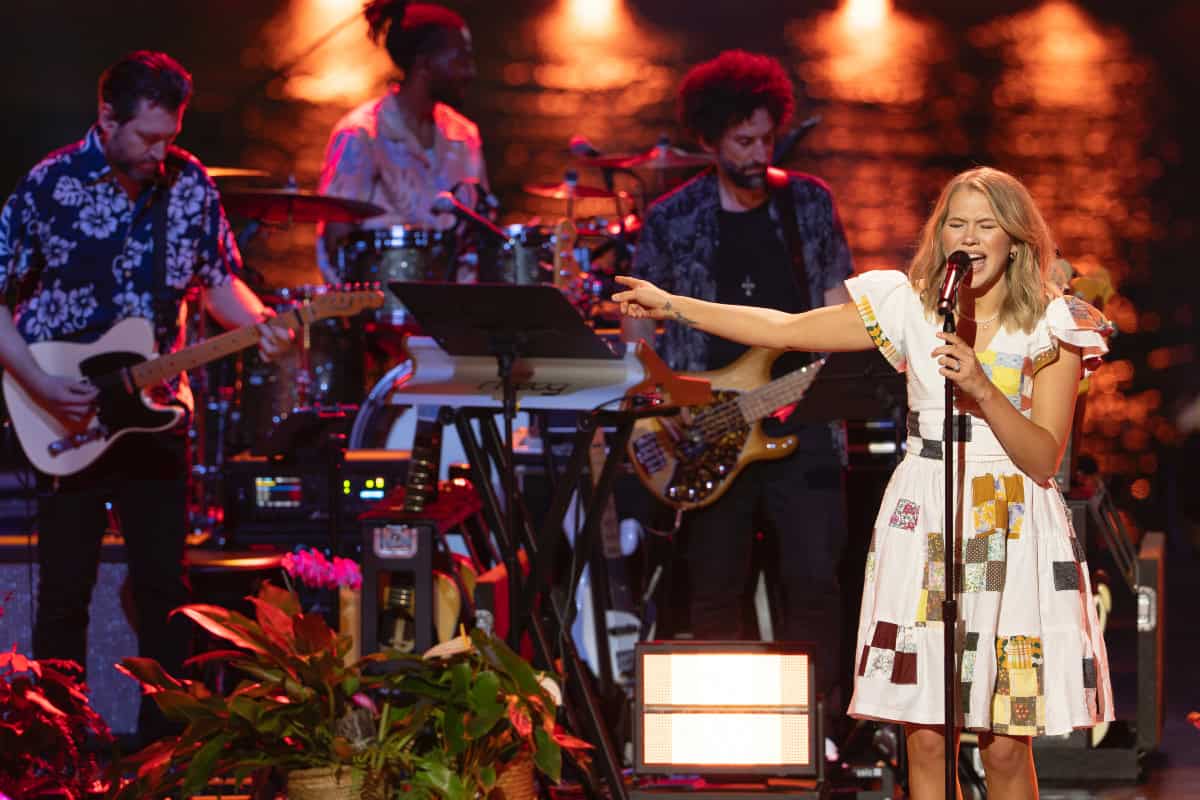
On a competition stage where reinvention often determines survival, Hannah Harper didn’t just step forward—she broke new ground. Her performance of “Ain’t No Grave” on American Idol wasn’t simply another round in the journey to the Top 14. It was a declaration of artistic evolution.
For an artist rooted in bluegrass and gospel traditions, this moment signaled something bigger: expansion without compromise.

A Song That Demands Conviction
“Ain’t No Grave,” originally written by Claude Ely and later popularized by Johnny Cash, carries a weight that goes beyond melody. It’s a song built on defiance, spirituality, and raw conviction.
Harper didn’t approach it as a cover. She approached it as a message.
Blending the spiritual intensity associated with artists like Bethel Music and Molly Skaggs, she injected her own edge—something closer to a revival meeting colliding with rock energy. The result felt less like a performance and more like an eruption.

Letting Go of the Guitar—and Control
One of the most pivotal shifts in Harper’s growth came from a deceptively simple decision: putting down her guitar.
For a performer grounded in acoustic traditions, the instrument isn’t just accompaniment—it’s security. Without it, every movement, every gesture, every moment of stillness becomes exposed.
Mentored by Brad Paisley and Keke Palmer, Harper was pushed to rethink performance not as a static delivery, but as a full-body experience.
The challenge wasn’t just technical. It was psychological.
She described feeling “out of her body”—a familiar experience for artists stepping outside their comfort zones. But instead of retreating, she leaned into that discomfort. And that’s where the transformation began.
From Singing to Preaching
What made this performance stand out wasn’t just vocal power—it was presence.
At certain moments, Harper crossed a subtle but important line: she stopped singing and started testifying. That shift, noted by judge Lionel Richie, is what elevated the performance from impressive to unforgettable.
It’s a hallmark of gospel-rooted artistry—the ability to move from performer to messenger.
When that transition happens successfully, the audience doesn’t just hear the music. They respond to it.
And they did.
The Birth of “Resurrection Rock”?
Judge Luke Bryan jokingly dubbed Harper’s sound “Resurrection Rock,” but the label captures something real.
What Harper created in that moment wasn’t easily categorized. It wasn’t traditional gospel. It wasn’t pure rock. It wasn’t country in the conventional sense.
It was a fusion—faith-driven storytelling delivered with the intensity and scale of modern performance.
In an industry that often rewards clear genre boundaries, creating something undefined can be risky. But it can also be memorable. And memorable is what keeps contestants moving forward.
A Family in the Front Row—and at the Center
While the performance itself carried power, the emotional foundation behind it added depth.
Harper’s family—her husband and three young sons—were present in Hawaii, turning what could have been a high-pressure environment into something grounding. She spoke about the surreal experience of seeing them in the audience, describing it as both a dream and a source of calm.
That presence matters.
It reframes the performance from a solo pursuit into a shared experience. Every note carries not just ambition, but purpose. And that purpose translates.
The Art of Getting Out of Your Own Way
Perhaps the most insightful feedback came from Carrie Underwood, who recognized a familiar pattern: overthinking.
It’s a paradox many performers face. The more aware you become of your movements, your voice, your presence—the easier it is to lose the very instinct that makes you compelling.
Her advice was simple but critical: stop thinking, start telling the story.
During “Ain’t No Grave,” Harper showed flashes of exactly that—moments where instinct took over and the performance became effortless. Those moments are what the judges—and the audience—are now waiting to see fully unleashed.
Growth in Real Time
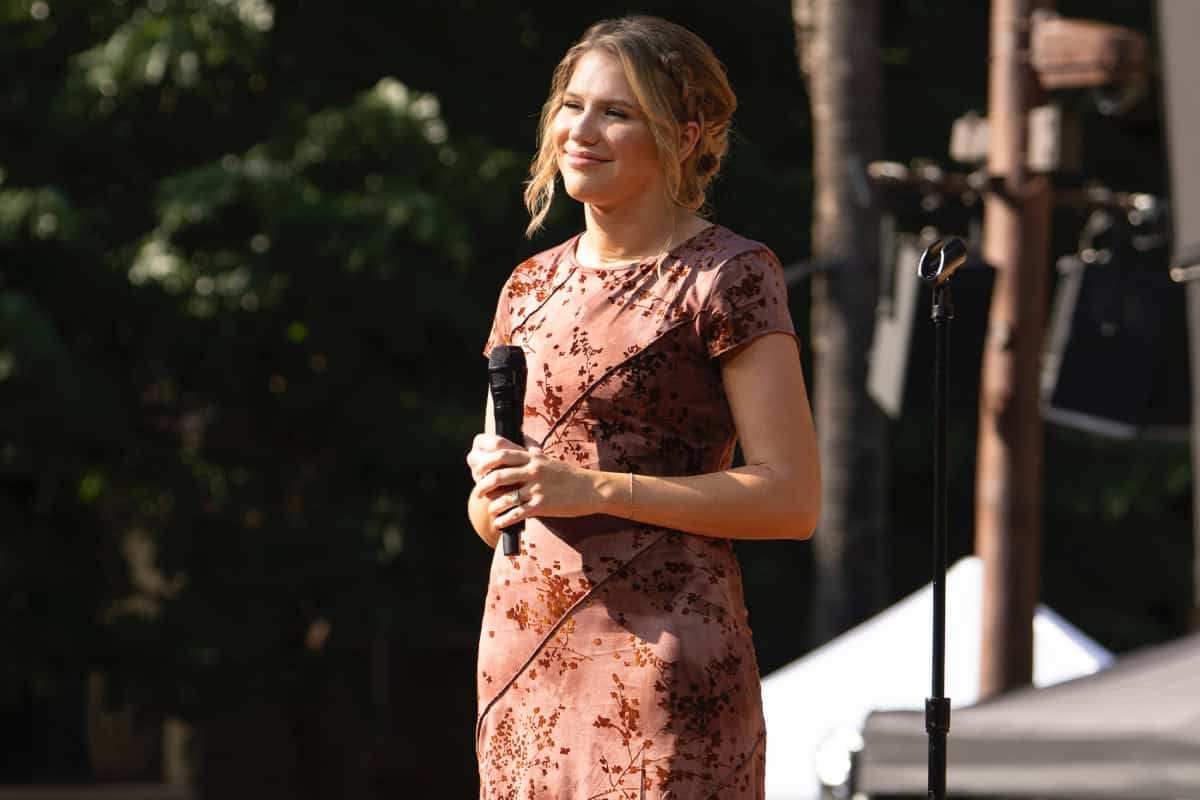
What makes Harper’s journey particularly compelling is its visibility. This isn’t a polished, finished artist presenting a final product. It’s an artist evolving in real time.
From her emotional original audition to her Appalachian gospel showcase, and now to this high-energy, genre-blending performance, each round reveals a new layer.
She described it herself as “peeling layers off”—a process that’s as uncomfortable as it is necessary.
But it’s also what makes audiences invest. People aren’t just watching performances; they’re watching transformation.
Why This Performance Matters
In the structure of American Idol, certain performances become inflection points. They signal who a contestant is—and who they could become.
“Ain’t No Grave” feels like that moment for Hannah Harper.
It proved she can:
-
Step outside her comfort zone
-
Command a stage without relying on familiarity
-
Blend genres while maintaining identity
-
Connect emotionally at scale
Most importantly, it showed that her artistry isn’t fixed—it’s expanding.
Final Thought
Hannah Harper didn’t just perform “Ain’t No Grave.” She reimagined what it could sound like in her voice, in her body, and in her story.
And in doing so, she moved one step closer to something every great contestant ultimately needs—not just talent, not just relatability, but a distinct artistic identity.
If this performance is any indication, she’s not just finding it.
She’s building it.