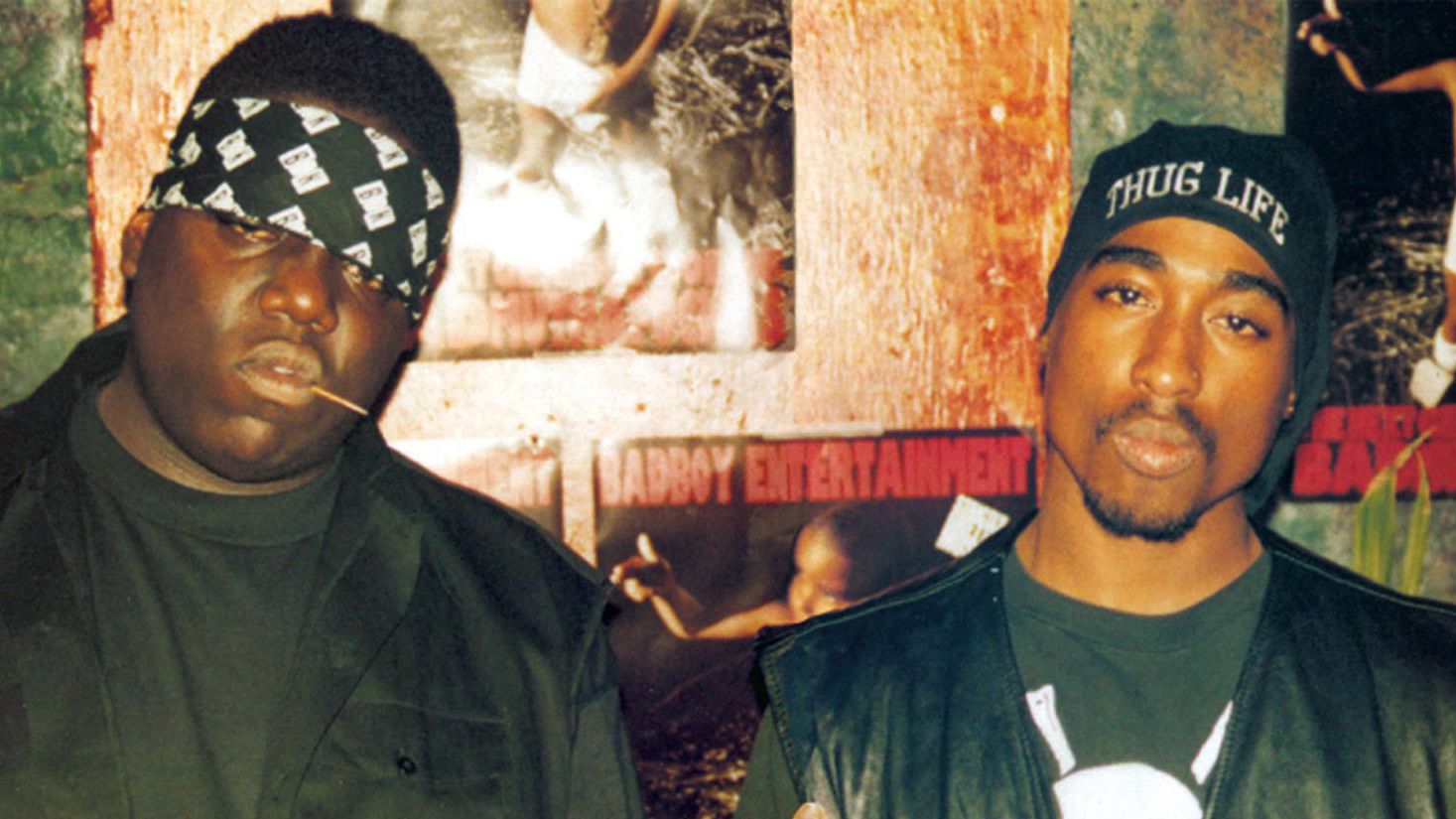
For decades, the murders of Tupac Shakur and The Notorious B.I.G. stood as hip-hop’s most haunting unanswered questions. Fans argued East Coast vs. West Coast, blamed record labels, law enforcement, even the government. But buried beneath the mythology was something far more brutal—and far more human. According to investigators, the truth wasn’t poetic. It was street retaliation, captured secretly on tape.
It all began on September 7, 1996, in Las Vegas. Tupac Shakur had just attended the Mike Tyson–Bruce Seldon fight at the MGM Grand, surrounded by Death Row Records executives and affiliates. Death Row was at its peak—untouchable, loud, and dangerous. Then came the moment that changed everything.

Inside the MGM lobby, Tupac spotted Orlando “Baby Lane” Anderson, a member of the South Side Crips. Months earlier, Anderson and others had allegedly robbed a Death Row associate of a Death Row medallion. In the world Tupac was moving in, that wasn’t petty theft—it was disrespect. Surveillance cameras later captured Tupac, Suge Knight, and their entourage attacking Anderson in broad daylight.
That beating, investigators say, was the spark.
Later that night, Tupac and Suge Knight left for Club 662 in a black BMW. At around 11:15 p.m., while stopped at a red light near Flamingo Road and Koval Lane, a white Cadillac pulled up beside them. Inside were four men, including Anderson and his uncle Duane “Keefe D” Davis.

What happened next rewrote music history.
Tupac was shot four times—twice in the chest, once in the arm, once in the thigh. Suge Knight was grazed by fragments but survived. Tupac fought for six days in the hospital, undergoing multiple surgeries, including the removal of his right lung. On September 13, 1996, Tupac Shakur died at just 25 years old.
For years, the case stalled. Witnesses refused to talk. The Las Vegas police ran into a wall of street code and fear. But behind the scenes, the LAPD quietly gathered intelligence—most notably from Keefe D himself.

In 2009, during a proffer session (a cooperation agreement), Keefe D spoke to Detective Greg Kading, unknowingly recorded by a hidden device. Believing his statements were protected, Keefe D admitted that Orlando Anderson was the shooter, acting in retaliation for the casino beating. According to Kading, this confession matched physical evidence, witness statements, and long-standing street rumors.
Then came the most explosive allegation of all.
Keefe D repeatedly claimed that Sean “Diddy” Combs had offered $1 million for the deaths of Tupac and Suge Knight—a claim Combs has strongly denied, and for which no charges have ever been filed. Investigators maintain that, regardless of any alleged bounty, the immediate motive was gang retaliation, not music rivalry.

For years, Keefe D remained untouched—protected by his cooperation deal. But everything changed when he began publicly talking. Podcasts. Interviews. A memoir. By turning his confession into content, prosecutors say he voided his immunity.
In September 2023, nearly 27 years after Tupac’s murder, Keefe D was arrested and charged with murder with a deadly weapon—the first and only arrest ever made in the case. His trial is currently scheduled for 2026.
But Tupac’s death didn’t end the violence.

Just six months later, on March 9, 1997, Biggie Smalls was gunned down in Los Angeles after attending a Soul Train Awards afterparty. He was 24 years old. Investigators believe his murder was retaliation—part of the same vicious cycle unleashed in Vegas.
According to Detective Kading’s findings, Suge Knight allegedly ordered Biggie’s killing, carried out by Wardell “Poochie” Fouse, a Mob Piru Blood associate. Knight has denied involvement, and no criminal conviction has ever been secured. Poochie was later killed in 2003, taking his secrets with him.

What makes the tragedy unbearable is what came out years later: Tupac and Biggie weren’t enemies in their final days. Suge Knight has said Tupac felt hurt—not hateful—and believed Biggie knew more about an earlier 1994 shooting than he admitted. Their feud, once deeply personal, had been amplified by media, labels, and street politics far beyond their control.
In the end, the East Coast–West Coast war wasn’t won by lyrics.
It was ended by bullets.
And nearly 30 years later, the hidden tape that Keefe D never knew was rolling may finally force hip-hop to confront a truth long buried beneath legend.