
The change didn’t arrive with noise or spectacle. It came quietly, almost unnoticed at first—the kind of shift you feel before you fully understand it. The moment Hannah Harper stepped onto the American Idol stage, something subtle but undeniable took hold.
Then the first note landed.
A Familiar Song, A Different Presence
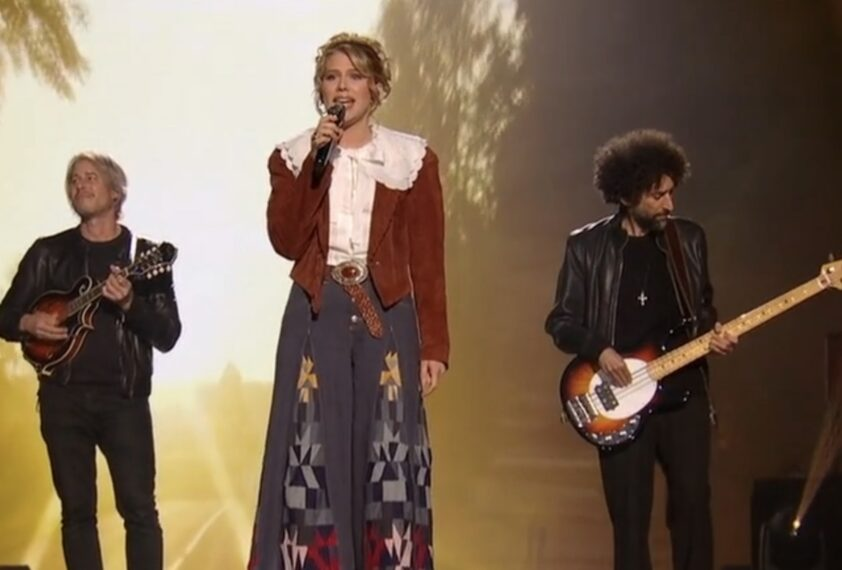
“Heads Carolina, Tails California” is not a song that demands reinvention. Its strength lies in familiarity, in the ease of its storytelling. Harper didn’t try to overpower that. She didn’t push it into something louder or more dramatic than it needed to be.
Instead, she leaned into it.
She let the rhythm carry the performance, allowing the song to move through her rather than forcing it around her voice. That choice set the tone, and it’s where the shift began.
The Moment the Room Leaned In

The audience didn’t react with instant applause. They leaned forward.
That distinction mattered. It signaled something deeper than surface-level excitement. Curiosity turned into connection, and attention sharpened into focus. Harper wasn’t asking for the spotlight. She was becoming it.
There was a looseness to her presence, but it never felt unprepared. It was controlled ease. Every movement appeared natural, yet precise. Every glance felt casual, yet intentional. It was confidence that didn’t announce itself—it revealed itself.
And that made it stand out.
Not Chasing the Moment—Carrying It
Many performers build toward a peak. They push for a moment, trying to create something unforgettable.
Harper moved differently.
She didn’t chase the moment. She carried it from beginning to end, letting it unfold without forcing it into shape. The performance didn’t build toward something—it sustained something.
Her voice reflected that same control. It didn’t strain for power, because it didn’t need to. There was a grounded quality to it, warm and steady, rooted in something beyond technique.
Each lyric felt lived-in, as though it had already passed through her before reaching the microphone. That authenticity made the performance feel believable in a way that technical display alone cannot.
The Power of Small Choices

What made the performance resonate were the details.
A pause held just long enough. A brief smile that appeared and disappeared. A word allowed to linger slightly longer than expected. None of it demanded attention, yet all of it held it.
She wasn’t filling the stage. She was shaping it.
By the time the chorus returned, the energy had shifted completely. What began as quiet attention had turned into full engagement. The audience was no longer watching—they were with her.
That is what separates a strong performance from a defining one.
A Silence That Meant Everything
The judges felt it as well. A specific kind of silence settled in—not empty, but focused. There were no distractions, no interruptions. Just presence.
For those few minutes, Harper held all of it.
What made the moment unforgettable wasn’t the song itself. It was the control behind it.
Not rigid control, but the kind that allows freedom without losing direction. She never rushed, never overreached, never stepped outside the moment she was creating. She trusted it, and in doing so, made everyone else trust it too.
A Moment That Changed the Conversation
By the final note, it didn’t feel like the end of a performance. It felt like the start of something new.
Moments like this don’t just earn applause. They shift perception. They change how a contestant is seen, turning potential into presence and presence into something more lasting.
After a performance like that, the question is no longer whether Hannah Harper belongs on that stage.
It becomes how far she can go—and whether anyone else is ready to keep up.