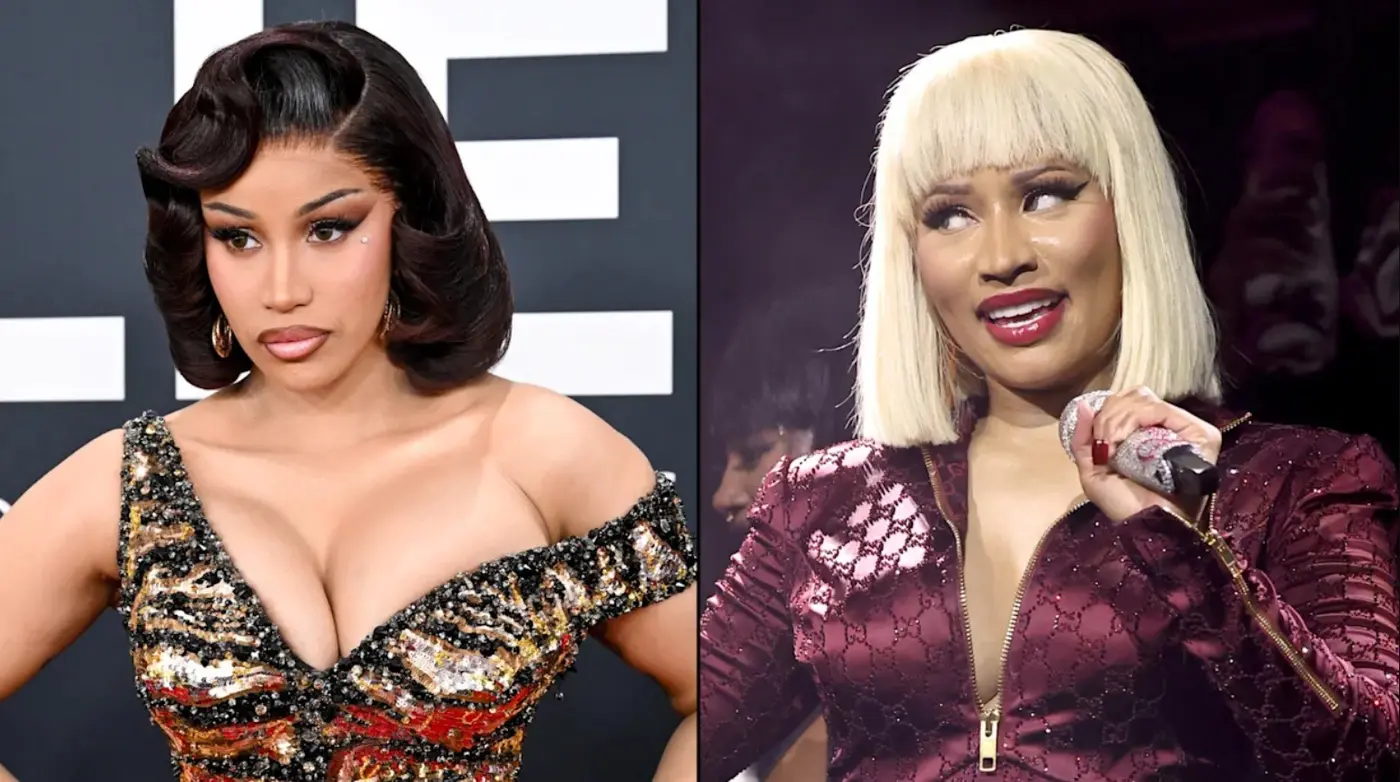
A pointed remark from Nicki Minaj has reignited tensions with Cardi B—and opened up a wider conversation about what empowerment really means in today’s culture.
The comment, delivered with unmistakable sarcasm, quickly spread across social media. “So this is what we’re calling empowerment now?” Nicki said, before adding, “Pick a side—you can’t preach one thing and sell another.” The tone and wording made it clear that her criticism was aimed at what she sees as contradictions in Cardi B’s public image.
A Critique That Struck a Nerve
At the center of Nicki’s remarks is a perceived inconsistency. She suggested that advocating for women’s empowerment while also promoting elements tied to stripper culture sends mixed messages, particularly to younger audiences who follow influential figures closely.
The delivery—sharp, ironic, and direct—amplified the impact. It wasn’t framed as a neutral observation, but as a challenge meant to provoke reaction and reflection.
A Divided Response
The reaction was immediate and deeply split.
Some supporters of Nicki Minaj argued that she voiced a concern that often goes unspoken. From their perspective, empowerment should be consistent and rooted in values that uplift women without reinforcing pressures linked to appearance or sexuality. They saw her comments not just as a personal critique, but as part of a broader cultural question.
On the other side, Cardi B’s supporters rejected the idea of hypocrisy. They argued that the critique oversimplifies a more complex reality. For them, Cardi represents a different kind of empowerment—one that includes embracing personal history, making independent choices, and refusing to conform to traditional expectations.
Two Views of Empowerment
This divide reflects a larger cultural conversation.
One perspective emphasizes consistency and responsibility, especially for public figures with massive influence. From this view, visibility comes with an obligation to present clear and careful messaging.
The other perspective prioritizes authenticity and personal freedom. Supporters of Cardi B argue that empowerment can include contradictions, growth, and the ability to define one’s own path without being confined to a single standard.
The Weight of Public Influence
Both artists hold global platforms, and their reach extends far beyond music. Their words and actions influence millions, including younger audiences still forming ideas about identity and self-worth.
This raises a broader question: how much responsibility should public figures carry for the messages they send?
For some, Nicki’s comments serve as a reminder that influence should be exercised thoughtfully. For others, expecting a perfectly consistent image limits the very freedom that empowerment represents.
Context That Can’t Be Ignored
The history between Nicki Minaj and Cardi B adds another layer to the situation. Their relationship has long included rivalry, subtle jabs, and occasional direct confrontations.
Because of this, it’s difficult to separate cultural critique from personal tension. Some see the comments as part of an ongoing feud, while others view them as a genuine contribution to an important discussion.
A Conversation Bigger Than the Moment
As the discussion spread online, it evolved beyond the initial comment. Social media amplified every angle, with quotes, interpretations, and reactions fueling ongoing debate.
What began as a single remark has become part of a larger dialogue about empowerment, influence, and the expectations placed on public figures.
More Than Just a Celebrity Dispute
Ultimately, this moment goes beyond two artists exchanging words. It reflects a broader cultural shift, where traditional ideas are being questioned and redefined in real time.
Whether one agrees with Nicki’s perspective or supports Cardi’s approach, the significance lies in the conversation itself. It shows how deeply people are engaging with the idea of empowerment—and how varied those interpretations can be.
In the end, the debate isn’t just about who is right. It’s about how society continues to define and understand empowerment in an evolving cultural landscape.