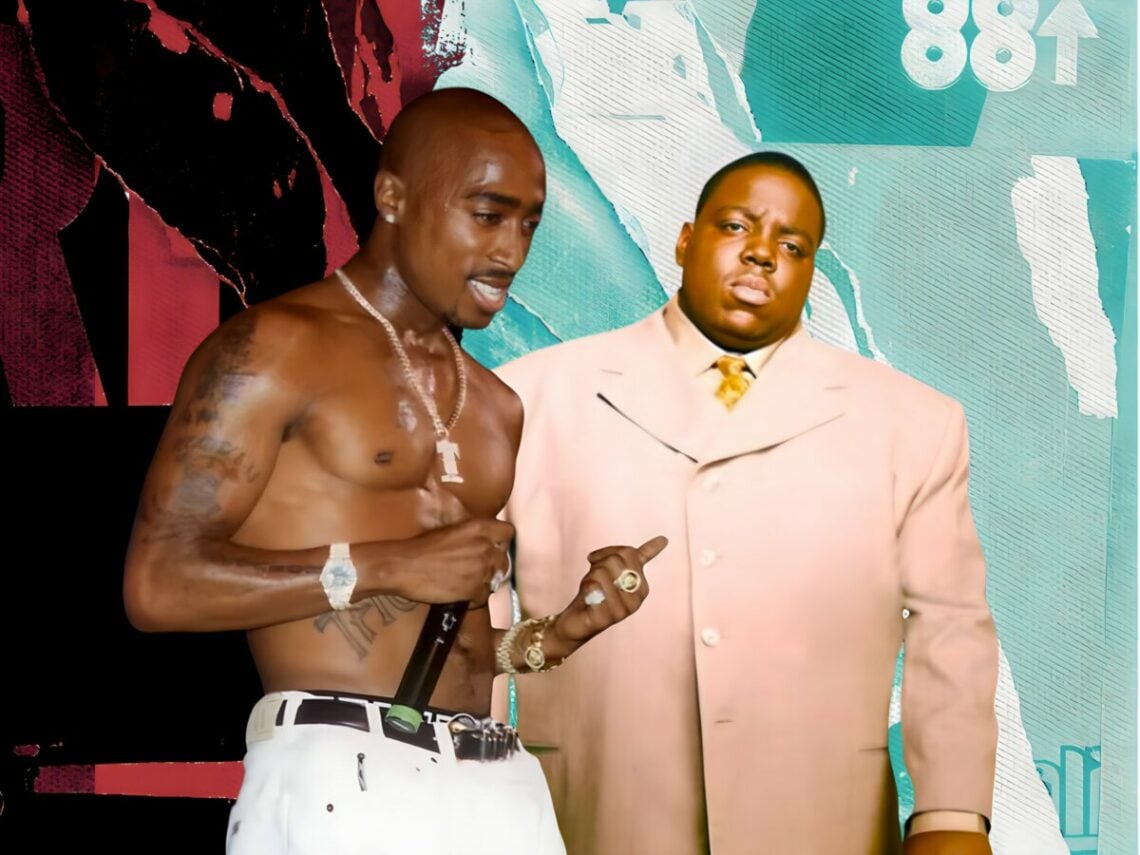
For nearly three decades, the rivalry between Tupac Shakur and The Notorious B.I.G. has remained one of the most tragic chapters in hip-hop history. Their public feud became a defining symbol of the East Coast-West Coast conflict, and both rappers were killed before they could publicly reconcile. But a revelation from someone who knew Tupac personally raises a haunting possibility: what if the legendary rapper had already decided to walk away from the conflict before his death?
According to former Outlawz member EDI Mean, Tupac was preparing to put his differences with Biggie behind him in the days leading up to the September 1996 shooting in Las Vegas. The account offers a dramatically different perspective on the final chapter of a rivalry that has shaped how generations of hip-hop fans remember both artists.
Mean, who was part of Tupac’s inner circle, claims the rapper returned from a trip to New York with a noticeably different attitude towards the feud. Rather than continuing the public confrontation that had dominated headlines and music releases, Tupac allegedly told members of the Outlawz that he was finished with the conflict.
The significance of that statement becomes clearer when considering just how personal the dispute between Tupac and Biggie had become.
Before their relationship deteriorated, the two artists had shared a friendship built around their mutual love of hip-hop. Tupac was already an established performer when Biggie was developing his career, and their early association represented a connection between two artists who would eventually become defining voices of their generation.
Their relationship changed dramatically following the November 1994 shooting of Tupac at Quad Recording Studios in Manhattan.
Tupac survived that attack but later publicly expressed suspicions about people associated with New York’s hip-hop scene. Biggie denied involvement, yet the accusations contributed to a growing personal conflict.
As tensions escalated, the dispute became increasingly connected to the rivalry between Death Row Records on the West Coast and Bad Boy Records on the East Coast.
Songs, interviews and public appearances added fuel to the confrontation. Tupac’s 1996 release “Hit ‘Em Up” became one of the most notorious diss tracks in rap history, featuring direct attacks on Biggie and other figures associated with Bad Boy.
By the summer of 1996, the rivalry had grown beyond a disagreement between two individual performers. It had become part of a wider cultural narrative that encouraged audiences and media outlets to view hip-hop through opposing regional loyalties.
That wider division is precisely what Mean now says Tupac had begun to reject.
According to his account, Tupac was uncomfortable with the way his personal disagreement had become an East Coast-West Coast conflict. Mean suggested that the rapper had started recognising the danger of allowing individual disputes to create hostility between entire communities of artists.
What makes the account especially compelling is the influence Mean attributes to Tupac’s mother, Afeni Shakur.
Afeni had been involved with the Black Panther Party, and her experiences with political activism formed an important part of Tupac’s upbringing. Her understanding of conflict, surveillance and division within political movements gave her a perspective that extended far beyond the music industry.
Mean claims Afeni spoke to Tupac about COINTELPRO, the FBI counterintelligence programme that targeted organisations including the Black Panther Party.
The programme’s documented activities included surveillance, infiltration and attempts to create divisions within political groups. Its history has remained an important subject in discussions about civil rights activism and government misconduct.
According to Mean, Afeni used that history to explain how divisions between groups could be exploited and intensified.
He recalled her discussing the tensions between Black Panther organisations on different coasts and referring to the violence that claimed the lives of activists including Bunchy Carter.
Carter and fellow Panther John Huggins were killed at UCLA in January 1969 during a confrontation involving members of a rival Black nationalist organisation. The killings occurred against a background of political tensions that were also affected by federal counterintelligence activities.
Mean’s account suggests Afeni saw a troubling parallel between those historical divisions and the increasingly hostile atmosphere surrounding hip-hop in 1996.
For Tupac, whose music frequently explored political injustice, racial inequality and the experiences of Black communities, such a warning would have connected the immediate conflict to ideas he had encountered throughout his life.
Mean believes the conversation affected the rapper’s thinking.
He described noticing changes in Tupac’s attitude after his mother raised the historical comparison, suggesting that the rapper had begun reconsidering his role in the regional feud.
That claim is important, but it also requires a distinction. Mean’s recollections provide a personal account of what Tupac allegedly intended. They do not establish that Biggie had been contacted, that negotiations had begun or that a reconciliation had been agreed.
There is no confirmation in the supplied account that Biggie knew Tupac was considering ending the feud.
Nevertheless, the possibility that Tupac was privately reassessing the conflict shortly before his death adds an emotional dimension to a story usually remembered through public hostility.
It suggests that the final version of Tupac presented to audiences through diss tracks and interviews may not have reflected every thought he was having about the situation in his last days.
On September 7, 1996, Tupac was travelling through Las Vegas in a vehicle driven by Death Row Records executive Suge Knight when gunfire struck their car.
The rapper sustained multiple gunshot wounds and died six days later, on September 13, at the age of 25.
Mean was travelling in a vehicle behind Tupac and Knight when the shooting occurred.
His proximity to the attack gives his recollections particular historical significance, although any account of a traumatic event must still be considered alongside other evidence.
Mean has described rushing towards Tupac’s vehicle after the shooting and hearing the wounded rapper warn him to get down because the attackers might fire again.
He also recalled turning around and finding himself facing a shotgun.
Those details illustrate the confusion and danger surrounding the moments immediately after the attack, when the people travelling with Tupac were trying to understand what had happened.
The shooting ended the possibility of any public reconciliation that Tupac might have been considering.
Six months later, on March 9, 1997, Biggie was also killed in a drive-by shooting in Los Angeles. He was 24 years old.
The deaths of two young artists, both of whom had achieved extraordinary influence before reaching their mid-twenties, became inseparable from the history of the regional rivalry.
Yet the circumstances of their killings and the personal motivations of everyone involved should not be reduced to a simple assumption that the feud directly explains every event.
The wider history includes competing accounts, unresolved questions and decades of investigation.
Mean’s latest recollections contribute another perspective, but they do not independently resolve those questions.
What they do offer is a reason to reconsider the familiar narrative that Tupac remained entirely committed to the confrontation until his final moments.
If Mean’s account accurately reflects Tupac’s intentions, the rapper may have been beginning to recognise that the conflict had grown beyond anything he originally intended.
That possibility is especially poignant when considering the influence Tupac continues to have on music and culture.
His catalogue includes songs addressing poverty, police violence, motherhood, friendship, political resistance and the pressures of fame. Although his confrontational records became central to the mythology surrounding the East Coast-West Coast feud, they represent only part of his artistic identity.
A decision to end the dispute would not have erased the damage already caused by public accusations or hostility. Nor would it necessarily have guaranteed that the wider regional tensions disappeared.
But it could have created an opportunity for two influential artists to change the direction of a conflict that had attracted enormous attention.
In my view, the most meaningful aspect of Mean’s account is not the suggestion that reconciliation was inevitable. It is the possibility that Tupac was capable of reconsidering a position that had become deeply associated with his public identity.
Changing course in the middle of a highly publicised rivalry can require as much courage as entering the confrontation in the first place.
There is no way to know whether Tupac and Biggie would eventually have repaired their friendship, recorded music together or simply agreed to leave each other alone.
Those possibilities belong to an alternative history that neither artist lived long enough to create.
But if Tupac truly intended to end the feud, his final days may have included an important personal decision that the public never had the chance to witness.
Nearly thirty years later, that is what makes Mean’s recollection so affecting. Hip-hop remembers the rivalry through the music, the accusations and the tragedies that followed. The possibility of a change of heart introduces a quieter and more human question.
Had Tupac survived Las Vegas, could he and Biggie have helped bring an end to one of hip-hop’s most damaging rivalries, or had the conflict already grown too large for either artist to control?