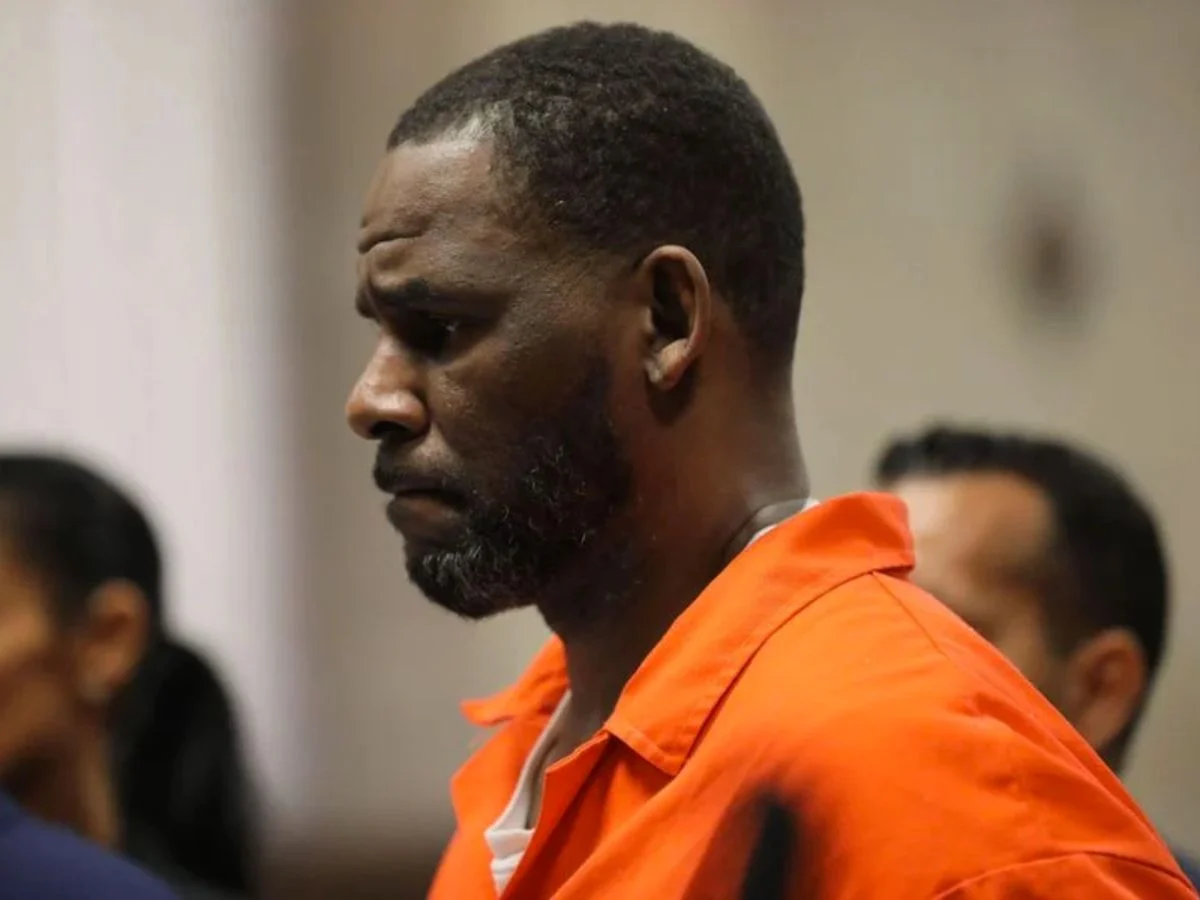
R. Kelly reportedly believes he could be walking out of prison much sooner than expected. But there is one major problem with that claim: his official release date remains nearly two decades away, and no confirmed legal decision has established that he is about to regain his freedom.
The latest discussion began after a man claiming to be a former fellow inmate shared an alleged conversation with the imprisoned R&B singer. According to Stefon Malone, Kelly recently expressed confidence that he would be returning home soon, despite serving lengthy federal sentences for serious criminal offences.
Malone made the claim in a Facebook post, describing what he said was a telephone conversation with the singer. He also shared photographs purportedly showing the two men together and an autographed drawing he claimed Kelly had given him while they were incarcerated.
The posts have attracted attention because of the enormous difference between Kelly’s reported optimism and his documented legal situation.
According to the Federal Bureau of Prisons release information cited in the original report, Kelly is scheduled for release on 21 December 2045. That would make him 78 years old when he leaves federal custody, assuming the date remains unchanged.

So where could the singer’s reported confidence be coming from?
One possible explanation lies in his previous efforts to secure presidential intervention, although there is no verified evidence connecting Malone’s account to any new decision by the White House.
In July 2026, Kelly sought a commutation of his sentence from President Donald Trump. The request became public through the Department of Justice’s Office of the Pardon Attorney, bringing renewed attention to the possibility of executive clemency.
A commutation would not necessarily erase Kelly’s convictions. Instead, it could reduce the amount of time he is required to serve, depending on the terms of any presidential decision.
That distinction is particularly important because Kelly’s imprisonment is the result of multiple federal criminal proceedings rather than a single conviction.
The singer, whose full name is Robert Sylvester Kelly, was convicted in New York in 2021 of racketeering and offences connected to violations of the Mann Act. He subsequently received a 30-year federal prison sentence in 2022.
In a separate Chicago case, Kelly was convicted in 2022 of offences involving the sexual exploitation of minors and received an additional 20-year sentence in 2023. Most of that sentence was ordered to run concurrently with the New York sentence, with one year consecutive.
Together, those sentencing decisions explain why Kelly faces approximately 31 years of federal imprisonment rather than the simple addition of both sentences.
The legal history also helps explain why a reported conversation with a former inmate cannot be treated as evidence that release is imminent.
For Kelly to leave prison substantially earlier than his current scheduled date, there would need to be a legally recognised change affecting his imprisonment, such as successful executive clemency or another applicable judicial or administrative decision.
At present, Malone’s account does not establish that any such development has occurred.
The former inmate’s social media posts nevertheless provide an unusual glimpse into how Kelly may be discussing his future while incarcerated.
Malone claimed that the singer had offered him encouragement during their time together and given him a signed drawing as a personal keepsake. When commenters questioned whether he had actually spent time with Kelly, Malone reportedly responded by publishing additional photographs showing them together after a basketball game.
Those photographs may support Malone’s claim that he encountered Kelly in prison, but they do not independently verify the contents of the alleged telephone conversation or establish that Kelly has received information about an upcoming release.
That difference between personal testimony and official confirmation is central to understanding the story.
For decades, Kelly was one of the most commercially successful figures in contemporary R&B, achieving international recognition through songs including “I Believe I Can Fly”, “Ignition (Remix)” and “Bump n’ Grind”.
His musical career included chart-topping albums, Grammy Awards and collaborations with prominent artists across R&B and hip-hop.
He also worked with major rap figures, including Jay-Z, with whom he released the collaborative albums The Best of Both Worlds in 2002 and Unfinished Business in 2004.
Those achievements formed part of a career that eventually became inseparable from serious allegations of sexual misconduct and the criminal convictions that followed.
Kelly’s legal downfall marked a dramatic reversal for an artist who had once enjoyed extraordinary commercial influence.
The convictions were not simply the result of public controversy or untested accusations. Federal juries found him guilty of serious offences, and the resulting prison sentences reflected those judicial outcomes.
That context matters when considering public discussions about whether the singer should be released.
A presidential commutation, if granted, would be a legal exercise of executive authority. It would not, by itself, mean that the underlying convictions had been overturned or that the conduct established in court had been disproven.
Similarly, an artist’s previous musical success has no bearing on whether a criminal conviction is legally valid.
Kelly’s situation therefore raises questions extending beyond the celebrity speculation surrounding Malone’s Facebook posts.
It also highlights the difference between a prisoner’s personal expectations, the possibility of political intervention and the actual legal mechanisms governing release from federal custody.
The presidential clemency process is particularly significant because it operates separately from the ordinary appeals system. A president can commute a federal sentence without requiring a court to overturn the conviction, although there is no guarantee that any particular request will be approved.
Kelly’s application for clemency therefore represents a potential legal route to an earlier release, but the existence of that application is not evidence that a favourable decision is forthcoming.
There is also a human dimension that cannot be ignored. The people harmed by the criminal conduct established in Kelly’s cases have a legitimate interest in how his sentences are administered. Any serious discussion about early release must recognise their experiences alongside the legal rights available to the convicted singer.
From an editorial perspective, the most revealing aspect of this story is the contrast between the confidence attributed to Kelly and the absence of a publicly confirmed change to his sentence. A former inmate’s account may generate curiosity, but it cannot substitute for an official legal development.
For now, the reported conversation remains an unverified account of Kelly’s expectations, while his scheduled release date remains 21 December 2045.
The question is whether Kelly has a genuine reason to anticipate a change in his circumstances or whether his reported optimism simply reflects his hopes for the future. Until a court, the White House or another relevant authority confirms a development, there is no established basis for saying his release is imminent.
And that leaves a difficult debate: should a presidential commutation ever shorten the sentence of a celebrity convicted of offences as serious as Kelly’s, or should his existing prison term remain in place regardless of his former musical influence?